History and traditions · The place
Rock-cut settlements in the Fasano area and the Living Nativity of Pezze di Greco.
The place
A rock-cut settlement carved into a geological formation typical of our land: the lama, a ravine shaped by ancient watercourses.
The lame, formed by river erosion in the Neozoic era, run across the land from the hills to the sea like riverbeds. The flowing water created near-vertical sides in the tuff walls, where it was easier for people to start digging rock-cut rooms, obtaining caves fit to be lived in since medieval times.
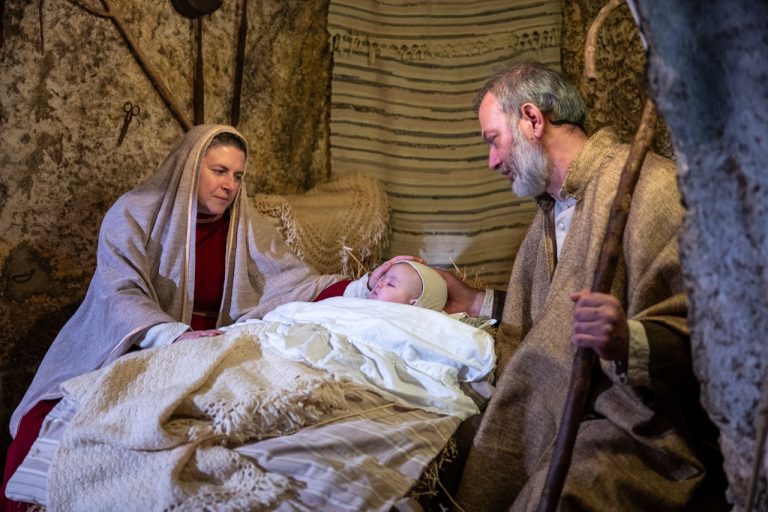
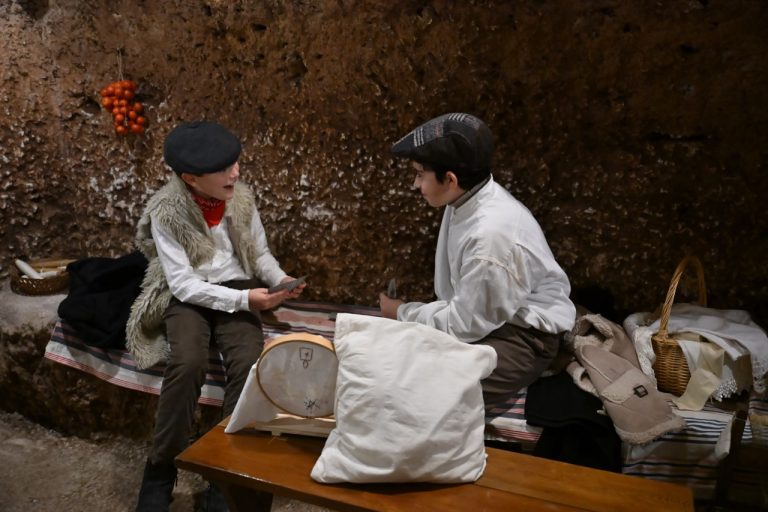
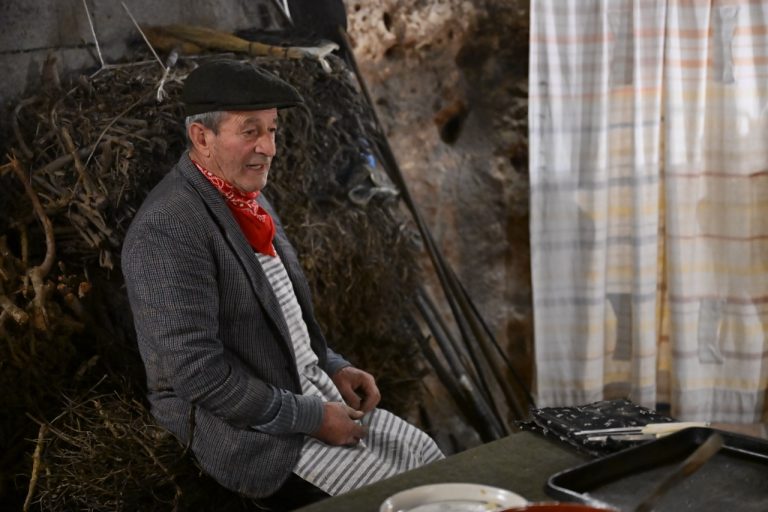
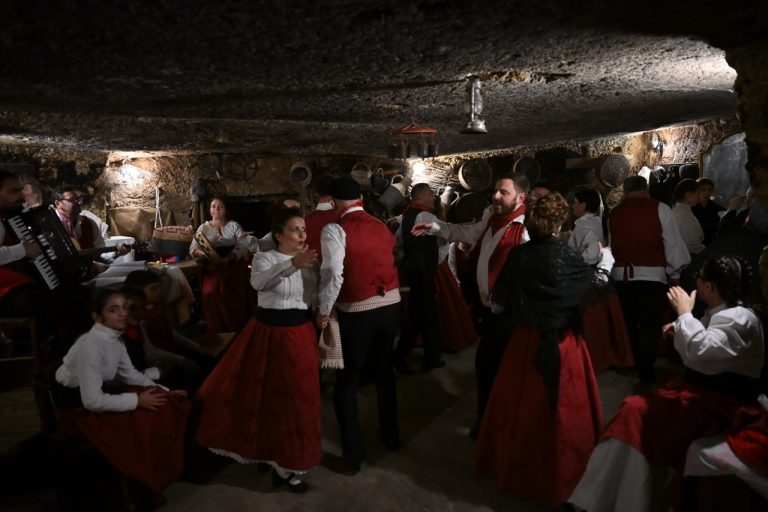
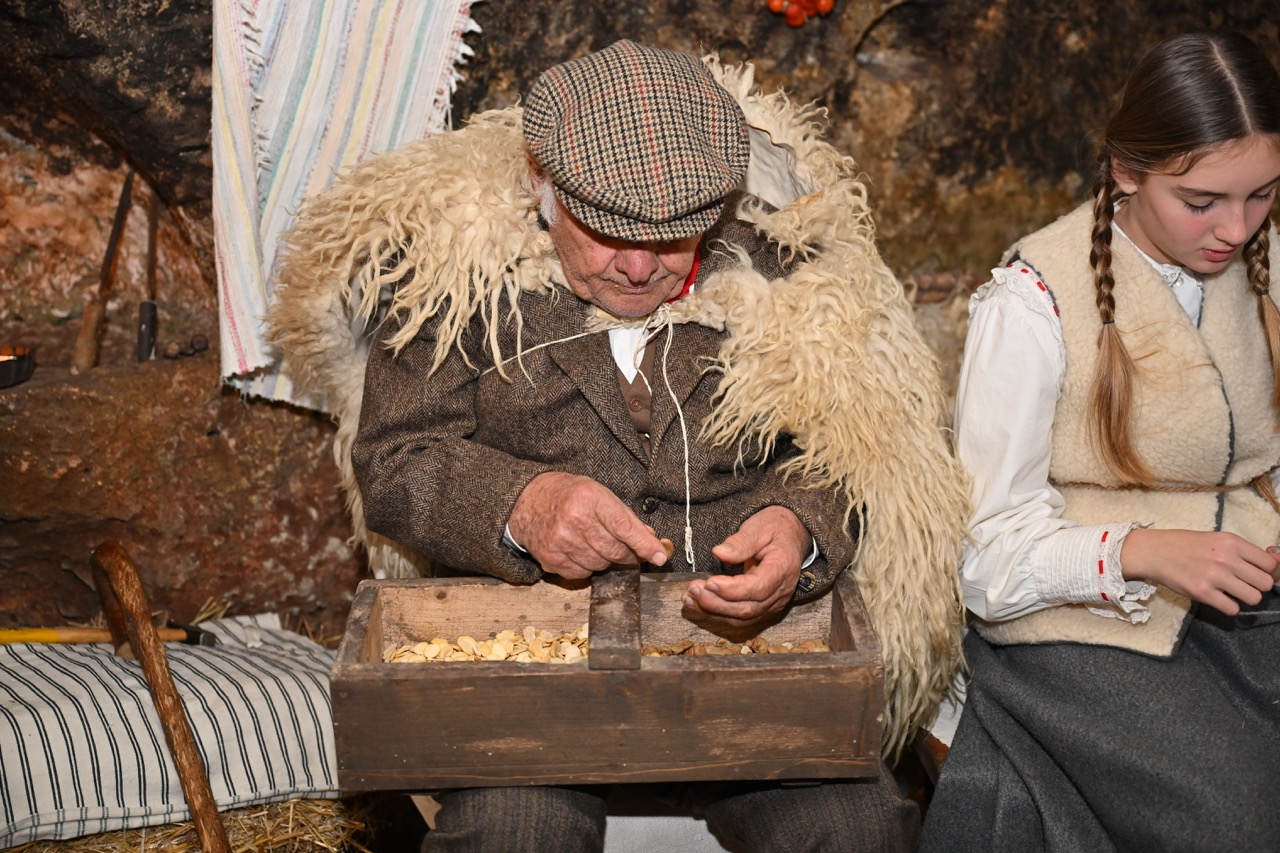
Since 1987 the people of the surrounding area, mostly farmers with a simple, practical and hard-working outlook, have been the creators of the Living Nativity, set in the evocative caves of Lama del Trappeto. The cluster of caves was made accessible after clearing away the mud left by rainwater. The characters of the Nativity step into the lives of our ancestors. Visitors immediately feel the authenticity of human relationships, the essence of life, the warmth and colour of the setting, and the smells and scents of a past that comes alive again.
In depth
Talk
Maria De Mola
Seminar "The History of the Living Nativity: Perspectives and Synergies"
Associazione Culturale "Presepe Vivente"
31 July 2005 · Underground oil mill, Pezze di Greco
I would like to thank those who invited me to speak about rock-cut settlements in this place so dear to me. It was the subject of my degree thesis, studied for the first time through an archaeological photogrammetric survey between 1980 and 1982, and I first explored it with my father, who died a few months later. He went with me far and wide across the countryside, unable to believe that so many years of study could end in wandering about in search of archaeological evidence to give value and substance to what could be made out in the aerial photographs provided by the University of Bari. To this day I have never stopped exploring the municipal territory and, after my family, my land of Fasano is what I love most. For this, thank you from the bottom of my heart.
"Tu scendi dalle stelle, o Re del cielo, e vieni in una grotta, al freddo e al gelo"
"You come down from the stars, O King of Heaven, and come into a cave, in the cold and the frost"
So goes the most famous Christmas lullaby of the Italian popular religious tradition, yet the detail of the cave, so important in the iconography of Christmas from the early Middle Ages onwards, is absent from the Gospels. One can certainly imagine that the manger mentioned by Luke the Evangelist was in a cave in Bethlehem, as is amply documented by some protogospels of the 2nd century AD, which refer to a precise quotation from Isaiah: "He shall dwell on high, in a cave of strong rock" (Isaiah 33:16). The fact is that the emperor Constantine had a basilica built on the presumed site of the cave, recorded as ecclesia speluncae Salvatoris. Thus, from the 6th century onwards, the cave appears in artistic iconography in place of the hut or shelter.
I believe that with this very brief introduction we have some clear references linking the events of the Christmas tradition to the subject of my talk, in which I will briefly try to explain the connections between a religious and a rural, peasant culture, not forgetting that in Bethlehem it was some shepherds who were the first to worship the Child in the manger, and the places, caves, hypogea, grottoes, morphologically well classified, of the rock-cut habitat of Fasano. Since the most remote antiquity, people have used the "cave" as a shelter from bad weather and the dangers of the environment, as a home, but also as a place to bury the dead and worship the gods.
For these purposes, natural karst cavities were used at first, and only later did the development of digging techniques and of needs themselves lead people to adapt these places to increasingly specific requirements, or to dig underground rooms from scratch. The main rock-cut centres of the Fasano area lie on the outer edges of the south-eastern Murgia, made of well-layered limestone rocks belonging to two formations: the Bari limestone and the Altamura limestone. Such a morphology strongly influenced the construction of the rock-cut settlements, located along the coastal strip, where the nature of the ground makes digging easy. Moreover, only in these areas can the land offer the morphological, hydrogeological and geotechnical features essential to meet the social, economic and religious needs of "living in caves".
Rock-cut settlements are very ancient and extremely widespread on almost every continent. The phenomenon does not concern only Italy or the Mediterranean basin, but also countries of Central and North America, China, many other Asian countries (India, Ceylon, Afghanistan, Iran) and Arabia (with the extraordinary example of Petra). It certainly takes on particular importance, with features somewhat similar to those of the Apulian settlements, in the countries directly facing the Mediterranean: Libya, Tunisia, Egypt and above all some regions of Asia Minor (Cappadocia, Lycia and Phrygia). In Cappadocia, for example, there are true rock-cut cities, stretching for several kilometres and arranged on as many as 8-10 levels, some dating back to the 5th century BC. The rock-cut examples in Italy and in Apulia itself, where the phenomenon developed especially in the Middle Ages, are very numerous and varied in type and period. Significant examples of rock-cut habitats in Apulia are those of Massafra, Mottola, Grottaglie, Bari, Monopoli, San Vito dei Normanni, many places in Salento and the Gargano and, of course, Fasano.
In our area, the most important morphological feature is the succession of terraces sloping down towards the Adriatic, running parallel to the coast and separating the coastal strip from the Murge plateau. The uniformity of these escarpments is broken by the furrows carved by river erosion, the "lame", which generally form micro-environments very favourable to human settlement, thanks to the presence of water, particularly fertile soil and a mild microclimate, and because they are natural routes of communication.
Coming down from the hills, the lame run perpendicular to the coast and, near it, flatten out until they reach the level of the coastal land. The area, which today is poor in water, bears the signs of a less arid geological past; many streams once flowed in the lame. Cisterns, still very numerous in all the rock-cut villages of Fasano, ensured the water supply. The flowing water created the typical morphology of the lama, with high near-vertical sides in the tuff walls where it was easier for people to begin digging rock-cut rooms, which can be grouped into a few basic settlement types; the most common model is a series of underground rooms made up of one or two connecting spaces dug into the side of the lama, forming small rock-cut complexes or, as in the special case of Lama d'Antico, true rock-cut villages. In the hollows of the land there are also many magnificent centuries-old olive trees, showing that olive growing was one of the main economic resources of a farming society which, moreover, made use of everything the natural environment offered: from livestock farming to gathering wild plants, from agriculture providing cereals, oil, wine, mulberry and fodder, to the use of the woods, hunting game and producing timber. The choice of site, besides morphological factors, was dictated by needs of safety and defence, and not least by religious needs. The cave is therefore the preferred type of dwelling in this particular habitat, and it was made more comfortable by improving its structures and adapting them to the various functions of the rooms: home, church, cemetery, workshop for farming activities, mill, oil press, wine press, "pharmacy", oil mill.
A final element characterizing our area is the presence, in all the rock-cut settlements from the 15th century onwards, of fortified masserie, which represent the evolution of the older rock-cut farming centres. The distribution of the rock-cut settlements is linked not only to the suitable geological substrate but also to good routes of communication, which follow earlier roads. In the Middle Ages the area had an efficient road system linking the various settlements to one another and to the nearby towns; as is well known, the Via Traiana was in use throughout the early Middle Ages, and the coastal city of Egnazia, today the largest archaeological site in Apulia and located within our municipality, was part of a series of land and sea routes connecting it with the regions of the East. After the destruction of Egnazia, a dense road network grew up alongside the Via Traiana, running parallel to it and today largely coinciding with the railway line. The most significant rock-cut settlements of the Fasano area, San Francesco, Lama d'Antico, San Lorenzo, San Giovanni and San Marco, lie along this ancient road system, still largely recognizable and walkable today; medieval documents show them connected to the small hamlets that formed the first urban and rural centres. The very settlement that hosts us stood near an important crossroads linking the hamlet of Santa Maria de Fajano, today's Fasano, with the hamlet of Santa Maria de Puteofaceto, today's Pozzo Guacito, both documented from the 11th century, as well as with the rock-cut centres of the "Sciurlicchio" and "San Martino" masserie, here in Pezze di Greco.
At the heart of the rock-cut village is the crypt. The underground churches have complex plans. The longitudinal plan is very common, enriched by a wide variety of solutions for the vaults and elevations; the interior is usually marked by columns or pillars dividing the hall into several aisles. In some cases the plan of the church opens out "like a fan" from the entrance inwards, since this distortion of the plan, also frequent in rooms for civil use, lets light enter and spread better inside the hypogeum (for example San Lorenzo). A liturgical element almost always present in rock-cut churches is the iconostasis, clearly of Eastern origin: a continuous low wall, left in place when the church was dug, separating the naos, the hall for the faithful, from the bema or presbytery, the area reserved for the officiating priests. Access to the presbytery was through one or two small openings in the iconostasis wall. The bema, reserved for the priests, may consist of one or more apses.
The central apse, usually the largest, holds the stone altar and is flanked by two areas: on the left the "prothesis", for the ceremonies preparing the sacrifice, and on the right the "diakonikon", used to store the sacred furnishings and for the vesting of the priest; the altar is usually a squared block of tuff left in place when the church was dug. The orientation of rock-cut churches, common to many medieval churches built in the open, is not random: the apses face east, towards the Holy Land. Traces of painted decoration, with beautiful frescoes, are very frequent; suffice it to say that our area preserves the finest examples of Apulian medieval painting, in the crypts of Lama d'Antico, recently identified by scholars as the church of San Nicola delle Sete, and of San Lorenzo, San Giovanni, Santa Vigilia and San Marco; this subject would require not one but many more seminars.
At first, precisely because of the strong Byzantine historical and artistic influence, attention to the phenomenon of "living in caves" focused on the study of the crypts and their frescoes, which were considered an expression of the culture and art of Byzantium, so much so that the crypts were wrongly called "Basilian", with reference to the large Eastern monastic community which, inspired by the teachings of Saint Basil of Caesarea, settled in many areas of our region. But in our area it is essential to consider also the Benedictine monastic component and the local lay groups that settled around the monastic communities. It is well known that between the 10th and 12th centuries Greek monasticism met, not only in our area but throughout southern Italy, the flourishing spread of the Rule of Saint Benedict; moreover, the monastic ideal expressed by Saint Basil and Saint Benedict was to reconcile the "active life" and the "contemplative life" in order to reach the salvation of the soul in God. Devotion to the active life gave a great boost, given the recurring type of agricultural landscape and economic system, not only to farming but also to land clearance, the transformation of woodland and the growth of human settlements in deserted or abandoned areas. The monks were naturally the beneficiaries of this territorial organization: a new form of land ownership developed, free from all obligations towards the State. For the local groups, living conditions free from taxation arose, and in the shadow of the monastic institutions they found a socially and economically organized life.
This socially organized life, shared between religious and lay communities, is confirmed not only by the relationship between the rock-cut habitat and human settlement, but also by elements such as the presence, in many rock-cut complexes, of better-finished caves for common use and for processing farm produce, of cave dwellings of different size and comfort, and of churches serving the whole village. The Eastern monasteries continued to survive despite the political and administrative transformation begun by the Normans, whose religious policy showed itself at first through a progressive Latinization of the episcopal sees and the founding of new Latin monasteries.
We must not forget the powerful boost given to the spread of Benedictine monasticism in our area by Count Geoffrey, nephew of Robert Guiscard, not only in the county of Conversano but also in the lands of Monopoli and Brindisi. The presence of Benedictine monks in our area is documented by the existence in the diocese of Monopoli, before 1086, the year the monastery of Santo Stefano of Monopoli was founded, of other monasteries dependent on San Benedetto of Conversano and on the Santissima Trinità of Cava: San Nicola "in portu aspero" and San Nicola in Pinna, in the Monopoli area, and San Pantaleone near Locorotondo, on the border with the territory of Fasano. Fasano, first as a hamlet and then as a developed town, was from 1086 until the second half of the 1800s a territory dependent on the Abbey of Santo Stefano of Monopoli, first under the jurisdiction of the Benedictines and then of the Knights of Rhodes and Malta, and its history was enriched by cultural ties that shaped its character. Two papal bulls of Pope Alexander III, of 1179 and 1180, addressed to the abbot of the Fasano monastery, show the rise in the Fasano countryside of many hamlets, all dependent on the two Benedictine monasteries in the area, Santo Stefano of Monopoli and San Giovanni de Fajano, which throughout the Norman period steadily increased their religious and economic power.
History has moved on, and there would be much more to say about rock-cut settlements and hamlets, monks and farmers, active and contemplative life, the darkness of the earth and the brightness of the sky, and how the cave and the light become the symbol of the life of people of every time and place, people who to be born must "come into the light" from the dark depths of the mother's womb, the cave in which we are conceived. The Living Nativity of Pezze di Greco therefore has a great merit: that of linking these places, once again, to the farming and rural tradition of our fathers, which began in these very lame and caves; it has the merit of bringing rock-cut civilization to the attention of so many people, from Fasano and beyond, who crowd these sites at Christmas and have the chance to rediscover, in a special geographical setting, history, art, religion and popular traditions.
Those who create and those who visit the Nativity of Pezze have one more opportunity to reflect on the importance of recovering the slow memory of the past, geographical, human, social and economic, the only one that can give strength to our frantic and chaotic modern times, and that invites us to stop and look within ourselves, so that each of us becomes a cave of our own, a cave of birth, a dark night awaiting the new day that we all trust will come as soon as possible.
Maria De Mola
31 July 2005
Keep exploring