History and traditions · Itinerary
A guide to the historical and cultural itinerary through the cave village of Lama del Trappeto.
The Living Nativity, historically set in the farming civilization of the late 1800s and early 1900s, is staged in a complex of caves carved into a geological formation typical of Apulia: the lama. The lame, ravines formed by river erosion in the Neozoic era, about 2 million years ago, at the dawn of human civilization, run across the land from the hills to the sea like riverbeds. As the tuff rock was easy to dig, the natural cavities were enlarged and adapted to the needs of small communities as early as the post-Roman period, to escape the raids of the barbarians.
The civilization of "living in caves" reached its peak around the 12th and 13th centuries, after Basilian monks fled the Near East because of the iconoclastic wars; rock paintings bear witness to it. Each cave corresponds to a dwelling. Inside, every cave follows the same layout, made up of a series of rooms: usually there is a larger one where all daily activities took place and, connected to it, smaller spaces where the beds were set up for the night, hearths to heat the room and cook food, and niches dug into the rock walls to store provisions and everyday tools.
Tap the map to view it full screen.
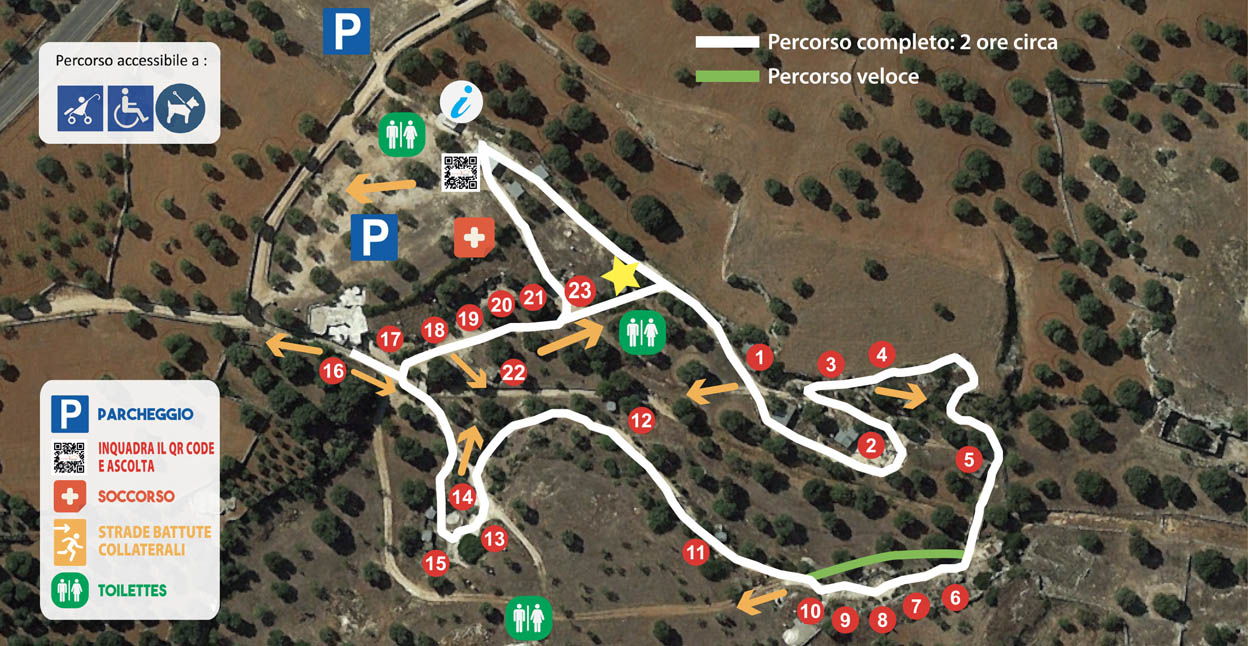
Follow the numbers on the map
Animals provided the power to plough the fields, carry goods and people, thresh cereals and legumes, crush olives, grind wheat and draw water. There are many native breeds: the Apulian Podolica cattle, horses and donkeys, sheep, and the local pig crossed with the wild boar. The only means of transport, mostly pulled by mules, were the traino to carry goods, the soprammolle, faster and easier to handle than the traino, to carry passengers, and the sciarretta, the gig or trap used by the masters of the masserie (fortified farmhouses).
u 'ngiégne
Once there were many norie in the countryside along the coast, called u 'ngiégne in dialect, "contraptions". They were used to draw brackish irrigation water, known as "water of Christ", from the water table just a few metres below the ground. A donkey or a horse, blindfolded, walked in circles harnessed to a sort of toothed wheel, which turned a second wheel set at right angles, driving a chain of buckets. The water was thus drawn from the well and poured into a collecting tank, ready to irrigate the coastal fields planted with tomatoes. This ingenious technique for raising water from underground was probably introduced by the Arabs: noria is in fact a Spanish word of Arabic origin.
u ferràr
The blacksmith forges a red-hot piece of iron, made malleable with the traditional tools: anvil, chisel and hammer.
a massaré d'Arcangele
The massaro runs the work of the masseria on behalf of the landowner. Small communities made up of families settled in the caves of the lame to feel safer and to invest their work in improving the land. Later these communities left the caves and moved to more comfortable buildings: the masserie.
The farrier is the craftsman who trims and shoes horses and other domestic equines (donkeys and mules). The Murgese horse shows off its thick mane. The menacing brigands tell our history.
The material for building houses is quarried from the rock that surfaces along the sides of the lame. The rock, commonly called tufo, white or whitish, fine-grained and very rich in Cretaceous marine fossils, made of calcium carbonate with a sub-crystalline structure in which calcarenite prevails, is easily extracted with a pickaxe and human strength.
i femmen da sàirfur
In winter these caves host the olive pickers (the women of the sairafùr) who come from the inland villages. To ease the fatigue of their hard work, in the evening they often hold "parties" where women and men sing and dance.
The women are busy making pettole, fried dough balls that tradition considers the food of the Baby Jesus.
a speziarì de don Pépp
The apothecary was a man of many trades: pharmacist and herbalist, grocer, part doctor, merchant, sometimes a wizard, an adviser and a confidant. He was indispensable, since his trade was bound up with commerce, medicine, cooking and social life in general. He was a pharmacist because he could prepare drugs, remedies and cosmetics, and a grocer because he sold aromatic herbs, raw sugar, salt and everyday objects, but above all he traded in spices, special and exotic flavourings that arrived from all over the East.
i causdùlcie
The beekeeper proudly shows his art of making the food of the gods. In the cave, the women are proud to share their recipes with visitors, enchanted by the scents. In popular tradition Christmas sweets have a double meaning, culinary and symbolic: the carteddate are the swaddling clothes or the crown of the Child King; the fecazzeddfracite are the pillow on which the newborn Saviour laid his head.
Pasqualin u cunzapiatt
In a hollow in the rock, above the tangled trunk of a carob tree, the craftsmen are at work mending broken pots with iron wire, while the ring of the hammer carves stone into indestructible basins.
This was a technique for turning wood into charcoal through incomplete combustion, by controlling the air. A conical mound of wood was built and covered with earth, with a central chimney and other side vents used to regulate the draught and therefore the amount of oxygen inside the kiln. When oxygen runs short, combustion stops and the wood turns into charcoal without burning to ash.
u mulén
In the millstone the grains of wheat release coarse flour which, passed through sieves, is separated into semolina, white flour and bran. The skilled hands of the women shape the different kinds of pasta. Meanwhile, some members of the family string the winter tomatoes onto cotton thread. The ramasole hanging from the vaults will bring the summer sun into the houses, and in winter, around the fire, the men will enjoy toasted bread dressed with a drizzle of olive oil and plenty of Regina tomatoes.
To thresh cereals and legumes, oxen or mules drag heavy stones; the crop is then winnowed with wooden forks: the wind carries away the lighter part, the straw, which is then pressed into bales with a piston tool operated by a lever moved by hand.
a cantén de Ziùdd
Standing along the busiest road, the tavern is the only place to eat and rest after a day's work or a long journey, but Joseph and Mary, travelling, find no room there. The ovens of the village fill the air with scents, the men call out their wares, and the camps lit by fires echo with the voices of the children.
u trappét de Massara Pìt
The fiscolaro weaves the fiscolo, the mat that holds the olive paste, and the basket maker weaves olive shoots. The millstone turns slowly, pulled by a blindfolded mule. At the orders of the nagghiero, the crew of oil workers turns the winch that presses the wooden presses (mammaredd), propped under the tuff vault. Pots on the fires cook the traditional broad beans while skilled hands craft handmade objects.
u falegnàm
While waiting, bent over his bench, the carpenter moves his plane up and down to shape the wood, a reminder of the dignity of work.
u fùrn da Mulenàr
Those without an oven of their own would bring their trays of bread, focaccia and various pans to be baked in the village oven, a meeting place where the women's chatter echoes loudly.
càs i recòtt
At dawn the shepherd milks his sheep and, after tending the flock, warms the milk over the fire and skilfully separates and transforms it into its many products.
u chettam
At the carding stage a gin separates the seeds from the raw cotton, which is fluffed with a bow-shaped tool that makes it soft and suitable for stuffing blankets and pillows, or for spinning with the spindle. The thread is used to weave nets, for embroidery, or worked on the loom, producing a fabric by interlacing two sets of threads at right angles: the warp and the weft.
a làn
Shearing the sheep produces raw wool which, through scutching, is cleaned and made ready for carding with the card, or cardidd. The wool is worked until it comes out in rolls ready for the spinning wheel, which produces the raw yarn. This yarn then passes through the spindle, becoming ever finer, and is finally wound into skeins. U féilafurce, the knife grinder, waits in front of the cave for the women called by his cry, and sharpens their tools on a turning pumice stone.
While waiting, the shepherds rest and chat about the events of the day.
Last stop
a grott du bommén
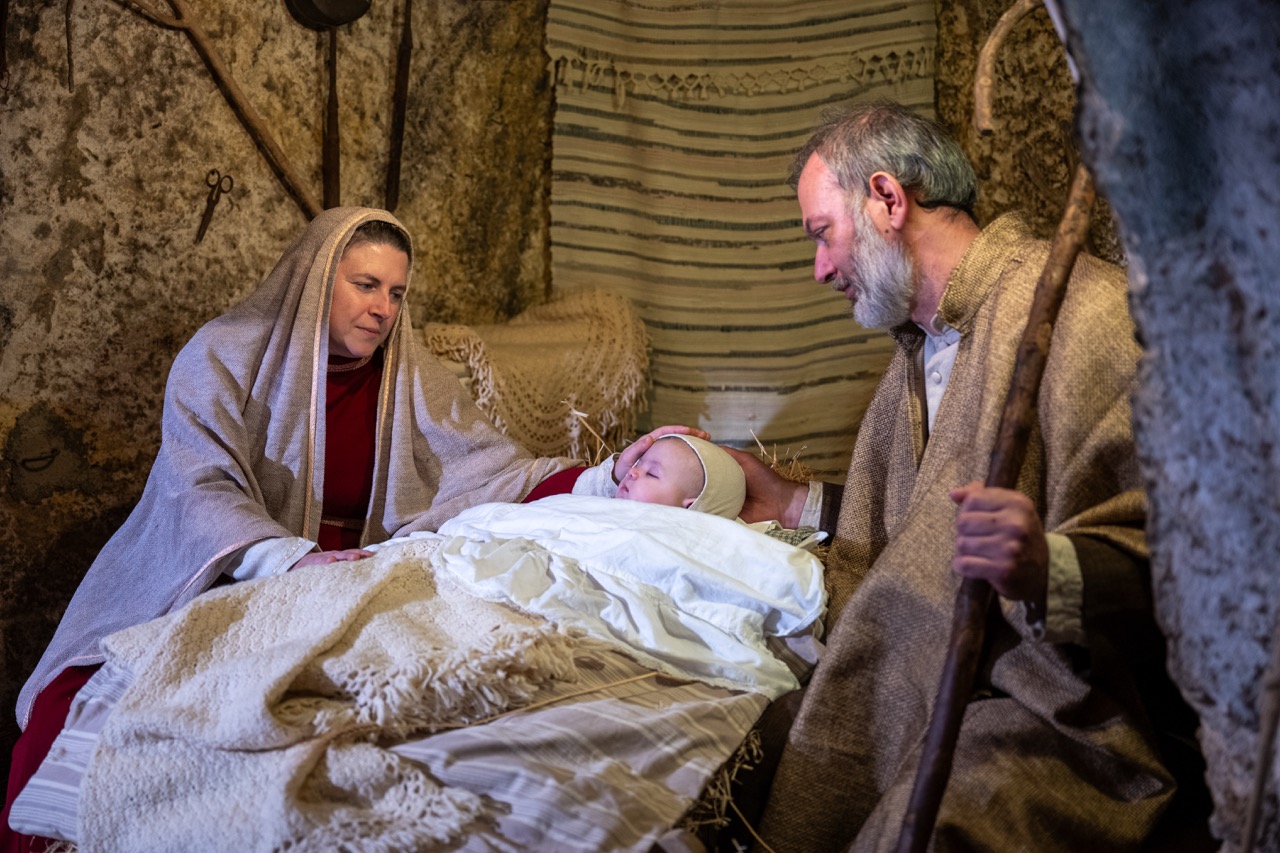
A great silence before the Nativity: no longer the laments of men crushed by the toil of every day, nor the joyful laughter of children, nor the chatter of women, but the echo of the announcement of a tomorrow full of hope.
With our Living Nativity, the spiritual and industrious life of the Byzantine and Benedictine monks, who together with humble people found comfort and refuge in these primordial places, comes alive again in the cave village.